AI Agents for Unbxd
Published 1 July 2026, 11 min read
Role
Product Designer
Timeline
Jun - Aug2026
Team
1 Designer1 PM2 Devs
Skills
Product DesignProduct StrategyPrototyping
Role
Product Designer (End-to-end)
Timeline
Jun - Aug 2026
Team
1 Designer, 1 PM, 2 Devs
Skills
Product Design, Product Strategy, Prototyping
Context
Unbxd is a software that powers the search bar and recommendations behind E-commerce sites. When you search for something and the results actually make sense, that's this working. It handles this at a massive scale too, tens of billions of searches a month. And it responds in under 10 milliseconds, basically instant.
Logo: Netcore UNBXD
The Problem
As an e-commerce search optimisation company, we've seen a few issues persist for over a year, ones that needed real restructuring and new experiences to fix. Solving them meant first understanding the data well enough to act with confidence. We chose to fix these 3 problems first because they affected the majority of our users. Here are the three problems we set out to solve.
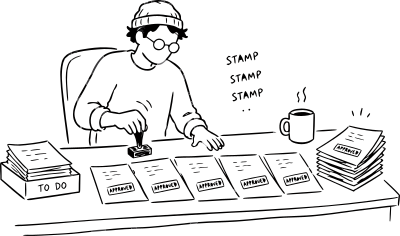
Repetition became the real bottleneck.
Repeating the same manual work
Boosting a product for a sale meant the same routine every time: pick it, set the promotion type, choose how long it runs, all by hand, across multiple screens. It wasn't hard, it was just repetition of the same steps every time.
Caption
Answers scattered across many reports
Search performance lived across several separate reports, so understanding last week meant juggling all of them yourself, there was no plain-language summary to just ask for instead.
Caption
The answer existed, just not in plain language
A product could get plenty of clicks and still rank low, and there was no way to know why. Just a debug panel full of numbers, and no answer.
Goal
Once we saw where the patterns kept pointing, we picked a direction for each one, three problems, three directions. What follows is where we decided to aim.
Caption
Build more promotions, with fewer steps
Right now, each promotion has to be created on its own, one at a time, even when you need many of them. The goal is to create several promotions together, with far less effort than doing them one by one.
Caption
Turn scattered data into insightful information
Promotion reports are just numbers in a table, with the important part buried inside them. The goal is to pull that out, turn it into plain sentences, and highlight what matters most.
Caption
Help users see the problem, and point toward an improvement
A listing can underperform for more than one reason: the words don't match what shoppers search, or the system doesn't understand what they meant. The goal is to make that reason visible, and point toward something worth trying.
Our Approach
The direction we landed on
Competitor analysis, user interviews, research, all of it pointed to the same place. The industry had already set the baseline — AI agents.
User Research
People had already started leaning on AI tools in their everyday work, without anyone telling them to. That quiet shift meant expecting a plain conversation to get something done wasn't unusual anymore, it was becoming normal.
Market Research
We saw competitors already shipping AI-assisted tools for search and merchandising, and getting real results from them. This wasn't an emerging trend anymore, it had already become close to a baseline expectation rather than a differentiator.
Constraints
Some of the decisions you're about to see weren't fully a choice. These three constraints shaped why the product looks like this.
Caption
We thought “One Agent” would be enough. Cute idea, terrible results.
We didn't expect the hard part to be memory. Pulling data from scattered silos ate time we didn't have, and the more context we piled on, the more it began hallucinating answers that sounded right and weren't.
Caption
The AI agent's visibility is limited to the page it's currently on.
It's like being in one room with the door shut. It only knows what's in that room, nothing about the rest of the house. The agent works the same way, whatever page you're on is the only room it's in.
Caption
Only one agent works at a time.
To use a different agent, you have to switch pages. Since it only exists on that page, switching means waiting for it to finish, or stopping it, either by leaving the page or pressing stop. There's no way to keep it running in the background while you move on to something else.
The three agents


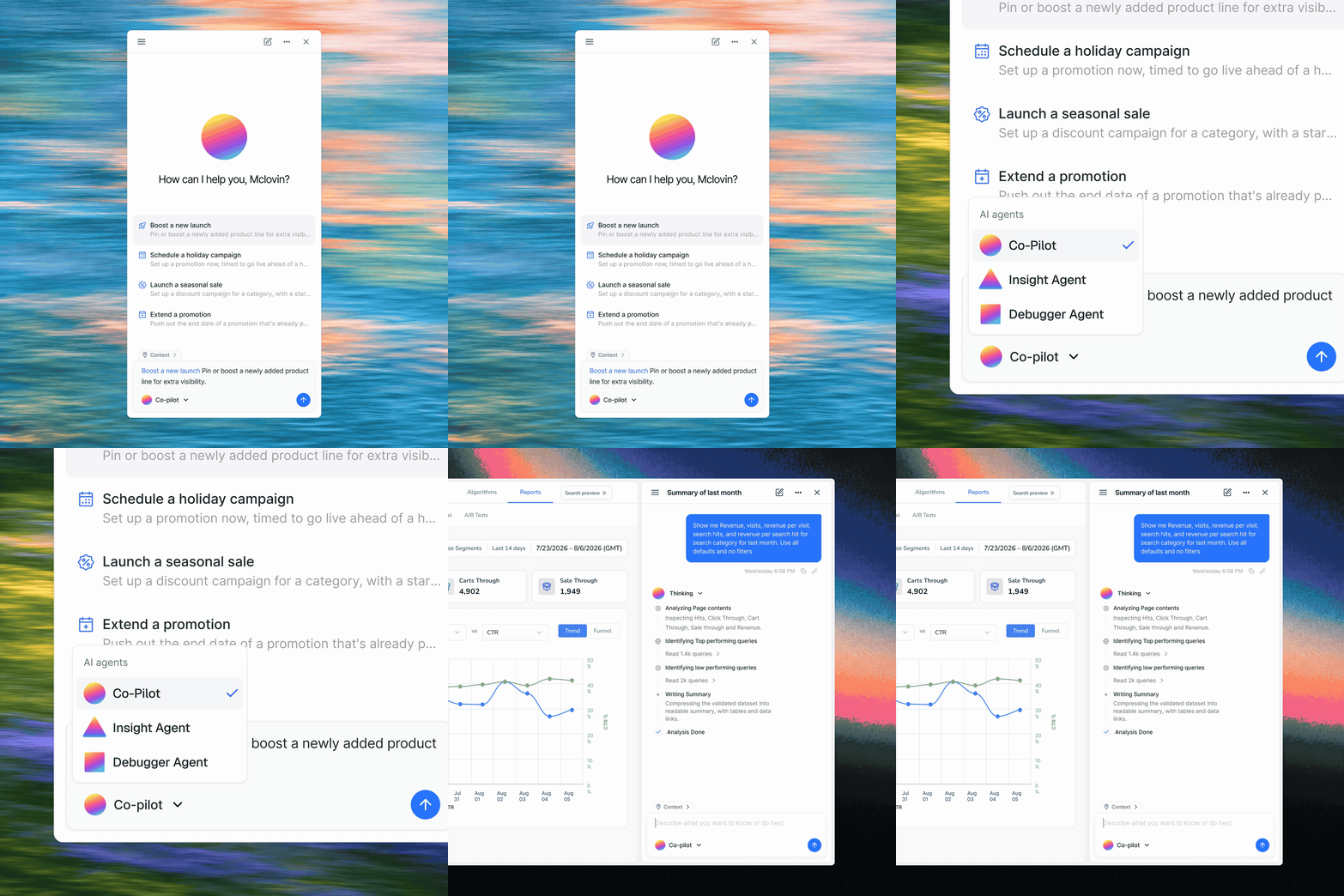
Co-Pilot


Insight Agent

Debugger Agent